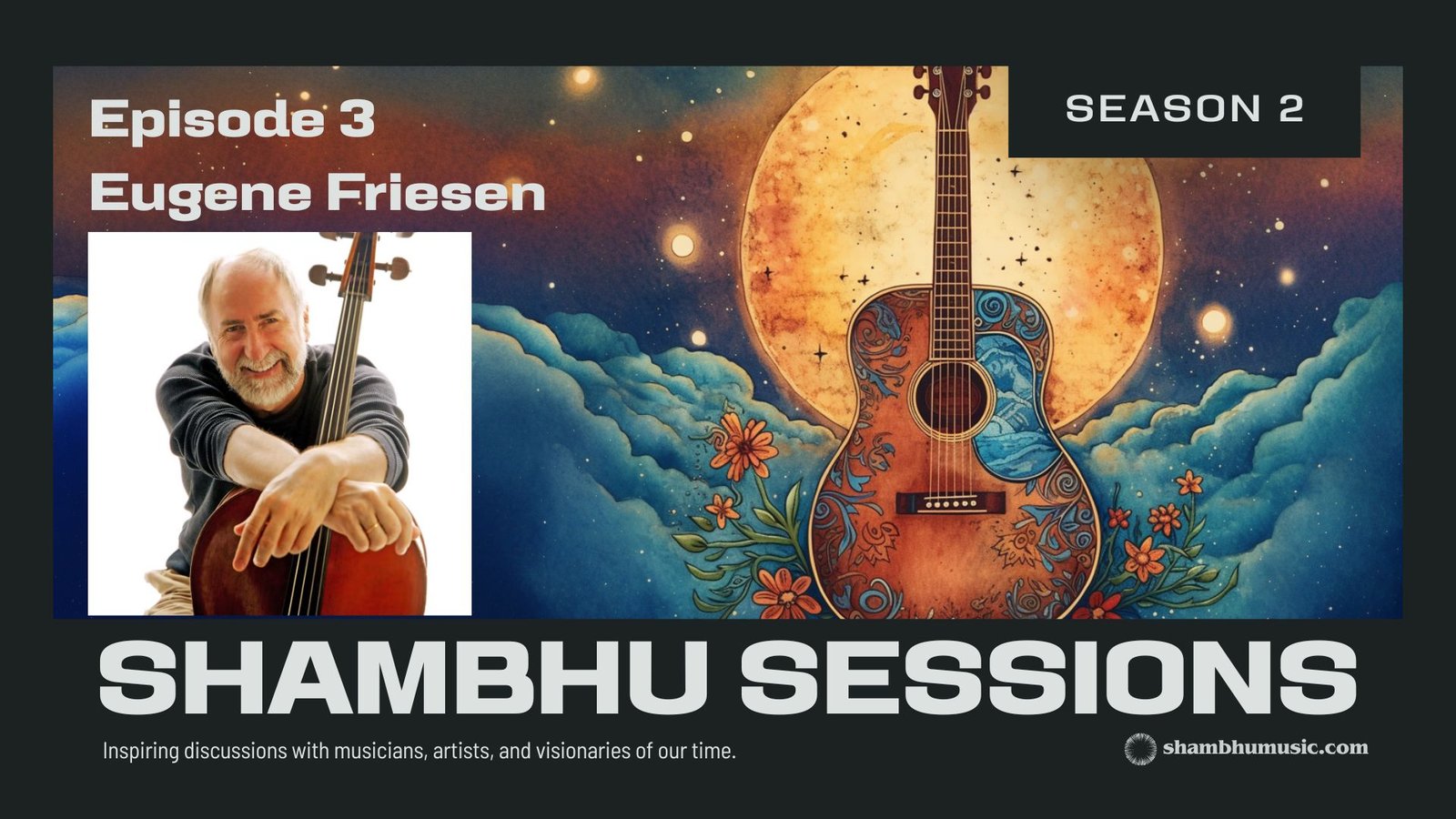
Eugene Friesen is one of the most gifted improvisers in contemporary music — a cellist whose work with the Paul Winter Consort and as a solo artist has expanded the possibilities of his instrument in profound ways. Our conversation ranged widely, from the nature of improvisation to the spiritual dimensions of music-making.
Shambhu: Eugene, improvisation is at the heart of your work. How do you think about that practice?
Eugene Friesen: For me, improvisation is about listening — deeply, openly, without agenda. When I'm improvising, I try to get my planning mind out of the way and just respond to what's happening in the moment. The music knows where it wants to go if I can get quiet enough to hear it.
Shambhu: That's very much how I approach my own practice. There's something almost meditative about it.
Eugene: Absolutely. The best improvisational music and the deepest meditation have the same quality — a kind of alert receptivity, an openness to whatever arises without clinging to it or pushing it away. You're fully present, but not controlling.
Shambhu: How do you prepare for that kind of openness? Is there a preparation practice?
Eugene: Yes — and paradoxically, it involves a lot of very disciplined practice. You need to have complete command of your instrument technically, so that in the moment of improvisation you're not thinking about technique. The technique becomes transparent. And then you can just listen and respond.
Shambhu: What role does the audience play in your improvisational performances?
Eugene: The audience is the other half of the music. Their listening shapes what I play — I can feel when people are really with me, and that changes everything. A listening audience is a collaborator.
This conversation reminded me of why I love this work and why collaboration with artists of Eugene's depth is so nourishing. I am grateful for his time and his wisdom.